Make a submission to the EPA on the port
Have your say: help save Exmouth Gulf from Gascoyne Gateway’s industrial port
Write your submission to the WA EPA
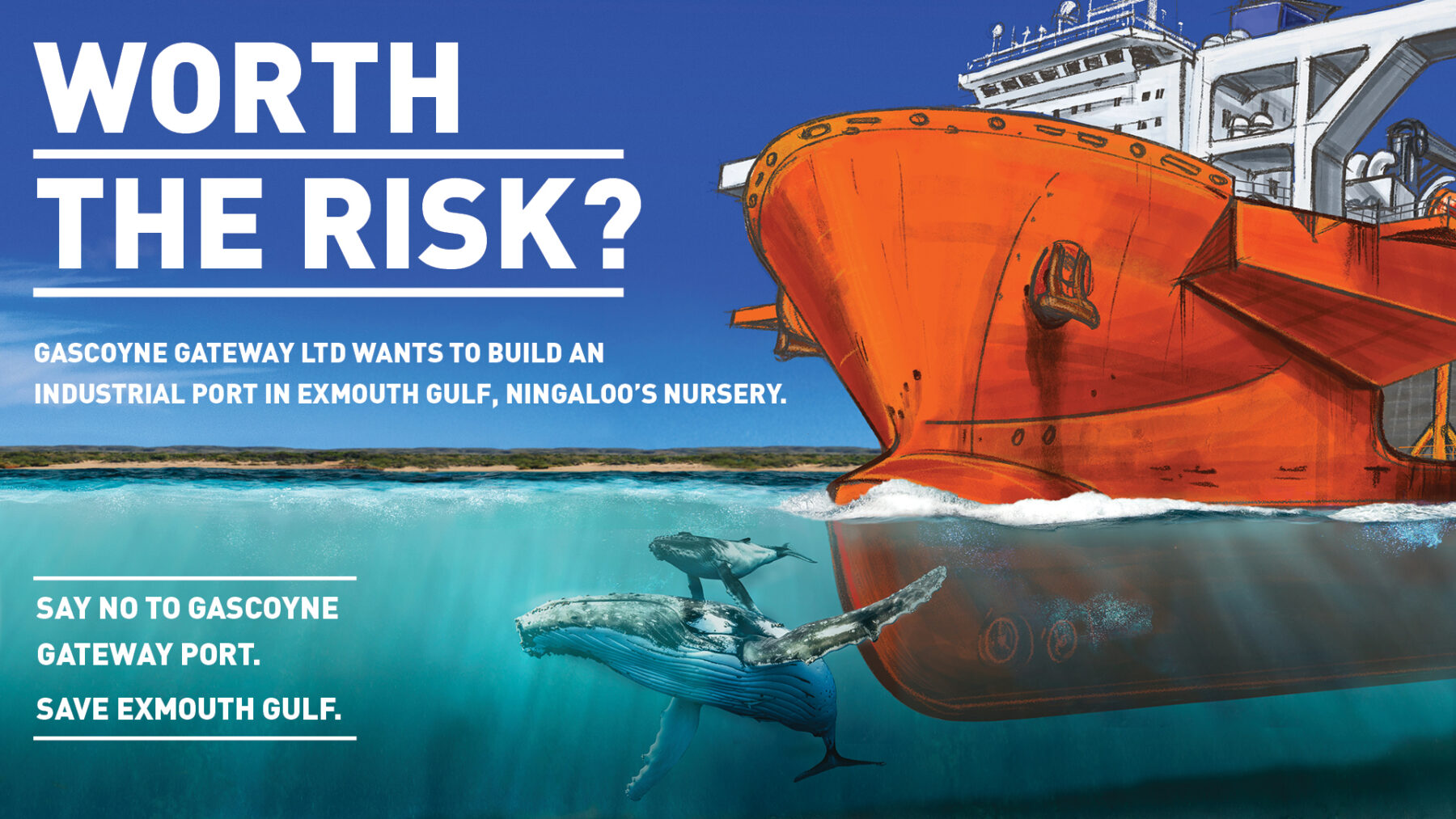
Gascoyne Gateway Limited (GGL) wants to build an industrial port next to Qualing Pool at Exmouth Gulf, next to a vital resting and nursing ground for one of the planet’s largest humpback whale populations. This is no place for a port! This project is completely incompatible with the incredible natural, cultural and social values of Exmouth Gulf and risks damaging this special place forever.
Right now, public comment on this proposal is open – and it’s important that community and local voices are heard. If you have a connection to Exmouth Gulf, whether you live here, have worked here, or have visited to experience its wonders, please make a short submission to the WA Environmental Protection Authority (EPA).
How do I make an individual submission?
Lodge your submission at the EPA’s online submission page.
You can type your comments directly online on the EPA’s page by following the instructions and questions, or attach a Word or PDF document less than 8MB.
Your submission doesn’t need to be technical or long. The EPA wants to hear from all kinds of people. Even a submission of a couple of paragraphs will make a huge difference, saying:
- Why you love Exmouth Gulf and think its environment is important.
- Your experiences in visiting/recreating in the area.
- Why you’re concerned about the port, and how it would damage the area and your enjoyment of it.
You do not have to fill out the whole submission.
Many questions are scientific but social impacts are also really important. It is ok to leave these scientific questions blank.
If you live in Exmouth or visit the town and are concerned about the port, your views are still valued.
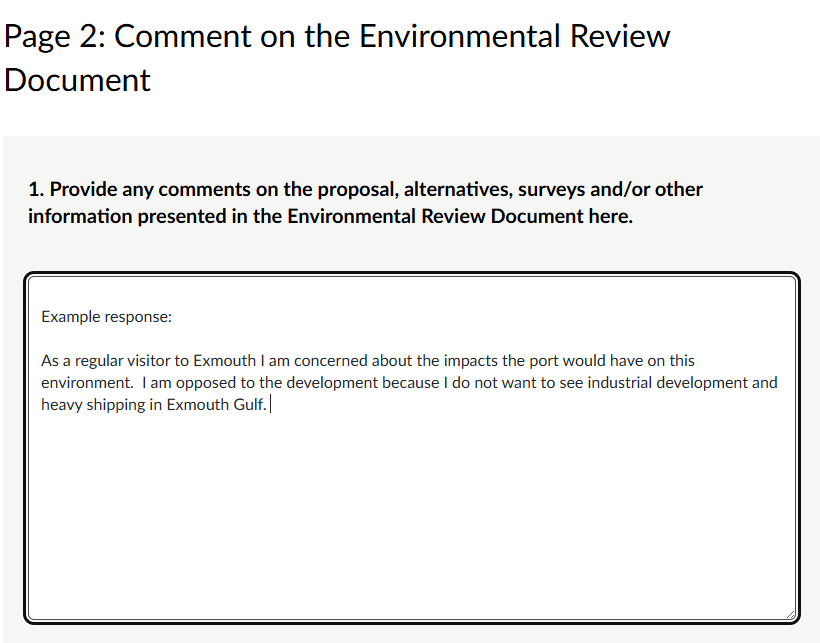
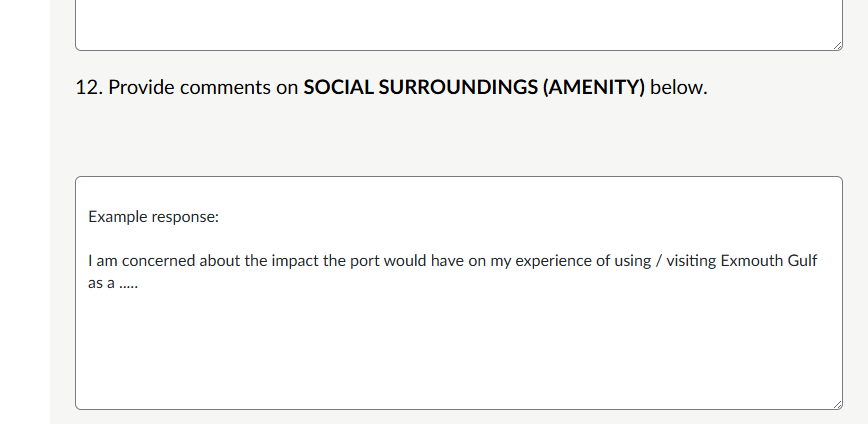
We have provided some notes in the sections below to help, but the more you can include your own concerns and personal experiences, the better.
It will show community opposition to the port and will amplify our science-based submission that this project poses unacceptable risks to Exmouth Gulf’s incredible marine and coastal environment.
Submissions close 16 November 2026
Thanks for standing up for the spectacular Exmouth Gulf and all its wildlife!
Information to help with your submission
What is the Gascoyne Gateway industrial port proposal?
- Gascoyne Gateway Ltd (GGL) is proposing a major port right next to Qualing Pool on the western side of Exmouth Gulf (10 km south of Exmouth town).
- The port would operate for over 100 years and damage the important and unique natural, cultural, and social values of Exmouth Gulf forever.
- A rock causeway and pylon wharf structure 1.5 km long would be constructed, to accommodate vessels up to 300 m in length, with a 3.5 km long dredged shipping channel to a depth of 13.5 metres.
- The port would draw large ships into Exmouth Gulf, including potentially cruise liners, fuel tankers, bulk and break-bulk cargo carriers and Defence ships.
- There would be dredging of more than 1 million cubic metres of seabed (the equivalent of >35,000 shipping containers).
- The landside component would include clearing of native vegetation, bulk fuel storage (up to 210 ML), laydown/storage areas, desalination plant (up to 2ML/day), seawater intake pipeline (500m from shoreline), brine discharge 500m from shore (4ML/day), solar farm (up to 10MW), bridgeworks, utilities corridors, and access roads.
- Three adjacent anchorage areas with a diameter of 1 nautical miles (1.85 km) each have been identified approximately 9.5 km to the north east of the end of the causeway.
Why Exmouth Gulf is no place for a port
|
The proposed Gascoyne Gateway industrial port is completely incompatible with the significant environmental, cultural and social values of Exmouth Gulf. Exmouth Gulf is a crucial part of the adjacent World Heritage-listed Ningaloo Coast ecosystem and a sanctuary for many threatened species. Following the recommendations of the WA Environmental Protection Authority’s strategic review of Exmouth Gulf and the Exmouth Gulf Taskforce, the WA Government has committed to protecting Exmouth Gulf by creating a jointly-managed marine park over the entire gulf, as well as a class A conservation reserve at Qualing Pool. In addition, the Australian Heritage Council is currently formally assessing Exmouth Gulf for National Heritage listing. The developer is seeking to construct its industrial port and shipping operation right within the planned Exmouth Gulf Marine Park and in an area earmarked for a land conservation reserve. Decades of research and government reports have demonstrated the high conservation value of Exmouth Gulf. A recent research paper found that Exmouth Gulf is a globally significant refuge for many marine megafauna species, and in its entirety provides critical habitat for threatened species; that its marine biodiversity is comparable in ecological value with the adjacent World-Heritage listed Ningaloo Reef. Exmouth Gulf and the connected Ningaloo Reef are already facing growing climate change impacts, including from the severe marine heatwave that hit the north-west coast of WA in 2024/25. This marine heatwave was the longest, largest and most intense on record for WA, resulting in the most widespread coral bleaching event ever recorded in WA, as well as loss of seagrass in Exmouth Gulf. We should not be adding considerably more pressure to this under stress ecosystem from an industrial port. |
Social values
The Qualing area, and particularly the Qualing Pool freshwater seep, has significant cultural value for the Traditional Custodians of the area.
The area is also a popular recreational area and local beach where people swim, snorkel, fish and boat.
The potential social impacts for Exmouth residents and visitors of an industrial port and shipping operation of the nature and scale proposed are significant and include:
- Damage to the cultural heritage value, including Qualing Pool.
- Disruption to recreational use of the popular local beach and nearshore marine environment.
- Reduction and control of access to areas of recreation.
- Significant loss of visual amenity and visual landscape values from the construction of industrial-scale port infrastructure, including diminishing the eco-tourism experience.
- Ongoing industrial port noise and light pollution, including for local residents.
- Potential amenity and safety impacts from heavy vehicle, port-related traffic on the roads.
Marine Habitat
The area where the port would be constructed is home to a rich diversity of marine habitat and life, including soft and hard corals, seagrass meadows and sponge gardens.
A diverse range of marine invertebrates live in the intertidal and subtidal habitats adjacent to Qualing Pool, including nudibranchs, crustaceans, molluscs and anemones.
The potential impacts of the industrial port to this fragile marine life include:
- Loss and damage from dredging of more than 1 million cubic metres of seabed (the equivalent of > 35,000 shipping containers) and the construction of the 1.5km rock causeway and pylon wharf structure, 3.5km shipping channel, and the three 1nautical mile diameter anchorage areas.
- Impacts from increased sedimentation and turbidity from construction, dredging, piling, propeller wash, and anchorage scouring.
- Impacts from reduced water quality from the release of contaminants from disturbed sediment, discharge of desalination brine, and surface discharge from land-based port construction and operations.
- Risk of hydrocarbon or chemical spills including from fuel handling, storage and vessel refuelling.
- Introduction of invasive marine pests from increased marine shipping activity.
These potential impacts are particularly concerning in the context of growing climate change impacts and pressures on the Exmouth Gulf marine environment, including the recent record marine heatwave in 2024-25.
Marine Fauna
Exmouth Gulf provides critical habitat and is a globally significant stronghold for threatened marine species.
The port wharf area, and the areas where the large ships would transit and anchor, are home to many conservation significant marine animals, including whales, dugongs, dolphins, manta rays, turtles and sea snakes.
Exmouth Gulf, particularly along this western side, is a critical resting and nursing ground for humpback whales. It provides calm and sheltered waters for mother-calf pairs, increasing their chance of survival as they make their southern migration.
The port would increase marine traffic and attract bulk cargo carriers, fuel tankers and other large ships down into Exmouth Gulf. This is no place for a port and major shipping traffic.
The potential impacts of the industrial port on marine animals include:
- Risk of ship strikes, including to humpback whales and calves, dugongs and turtles.
- The risk of vessel strike for humpback whales is high in Exmouth Gulf, because lactating mothers spend a considerable amount of time resting, with most of this just below the surface.
- Disturbance to marine mammals from underwater noise due to increased marine traffic, port activities and construction (pile driving, dredging and rock dumping).
- Ships would cross the humpback whale resting and nursing area and would disrupt the low-stress environment critical to humpback whales’ survival.
- Loss or degradation of habitat, including from dredging, pollution of marine waters, increased water sedimentation and turbidity and introduction of marine pests.
- Disturbance from artificial light pollution from ongoing port operations, including for marine turtles.
Flora and vegetation
The vegetation within the Qualing Pool area is highly diverse, with some being rare and of very high conservation value, such as the Qualing ephemeral wetland vegetation, making this site’s vegetation unique within the region.
There is also a rich biodiversity of flora in the area, with a number of Conservation Significant (Priority) species. A total of 41% of all flora species on the Cape Range are found in this relatively small area. A number associated with the freshwater wetlands are not known to occur elsewhere on the Cape.
The proponent found that 93% of vegetation within the project development area is in good to excellent condition.
The port project would clear up to 106.5 hectares of native vegetation as well as risking fragmentation of vegetation.
The port construction and operations would also pollute and degrade the surrounding environment, including from dust, vehicle traffic, contaminated surface water runoff, altered natural water flows, potential hydrocarbon and chemical spills, and the introduction and spread of weeds.
Inland waters
The Qualing area, where the port would be developed, is unique in containing examples of three different types of freshwater ecosystems: subterranean waterways, permanent freshwater pools and arid ephemeral wetlands.
The proposed port location is right next to Qualing Pool; a significant surface freshwater body on the North West Cape peninsula. Subterranean waterways connect this freshwater with the marine waters, delivering nutrients to Exmouth Gulf.
Just south of Qualing Pool, adjoining the port development area, is a significant ephemeral freshwater wetland. This wetland supports populations of shield shrimp and burrowing frogs that emerge after rare heavy rainfall events. Excess water, along with the nutrients it contains, drain into the Gulf at Pebble Beach. This wetland has not been properly studied and likely contains species not found elsewhere.
Building an industrial port in this Qualing Pool area would result in a high risk of contamination and other impacts to the surface and groundwater of these freshwater ecosystems, including through:
- Alteration to natural water flows, surface water catchment, groundwater replenishment, hydrological connectivity, and stormwater drainage.
- Contaminated surface water runoff and erosion from the port construction and operations.
- Potential hydrocarbon and other chemical spills and leaks.
- Construction of a bridge over the creek that feeds into Qualing Pool.
What is the public environmental review process?
Gascoyne Gateway Ltd’s Environmental Review Documents have been released by the WA Environmental Protection Authority (EPA) for public comment. In these documents, the developer describes the port proposal, their assessment of the likely environmental impacts and their proposed measures to manage impacts.
To view GGL’s documents, visit the EPA’s website below and click on 3. Assessment, then Environmental Review.
The project requires environmental approval by both the WA and Federal Environment Ministers (because it risks impacting many matters of national environmental significance). The EPA’s assessment and recommendation will be used to inform both decisions.
Protect Ningaloo will be making a submission to the EPA on behalf of the conservation sector. If you would like to add your name to this submission you can do so here. However, it’s really important that the EPA hears directly from locals and the broader community.